Bea Better Eating: Validating Bea’s 15-Day Challenge
Testing Habit-Forming Behavior Before Code — A Behavioral Experiment that Shaped Bea’s Product Direction
Immediately after releasing the MVP, I recognized that Bea lacked a true engagement hook—something to retain existing users and attract new ones. Before investing developer time, I wanted to validate an onboarding experience that could build early momentum.
Bea’s 15-Day Challenge became that experiment: a lean social and email /SMS campaign designed to test Bea’s tone, content, and behavioral framework. It quickly became our most pivotal validation milestone—proving that people were ready for compassionate, hypnosis-inspired emotional support at scale.
PHASE 1
Research: Why a Challenge, Not an App (Yet)
We needed real-world insight before investing in full development.
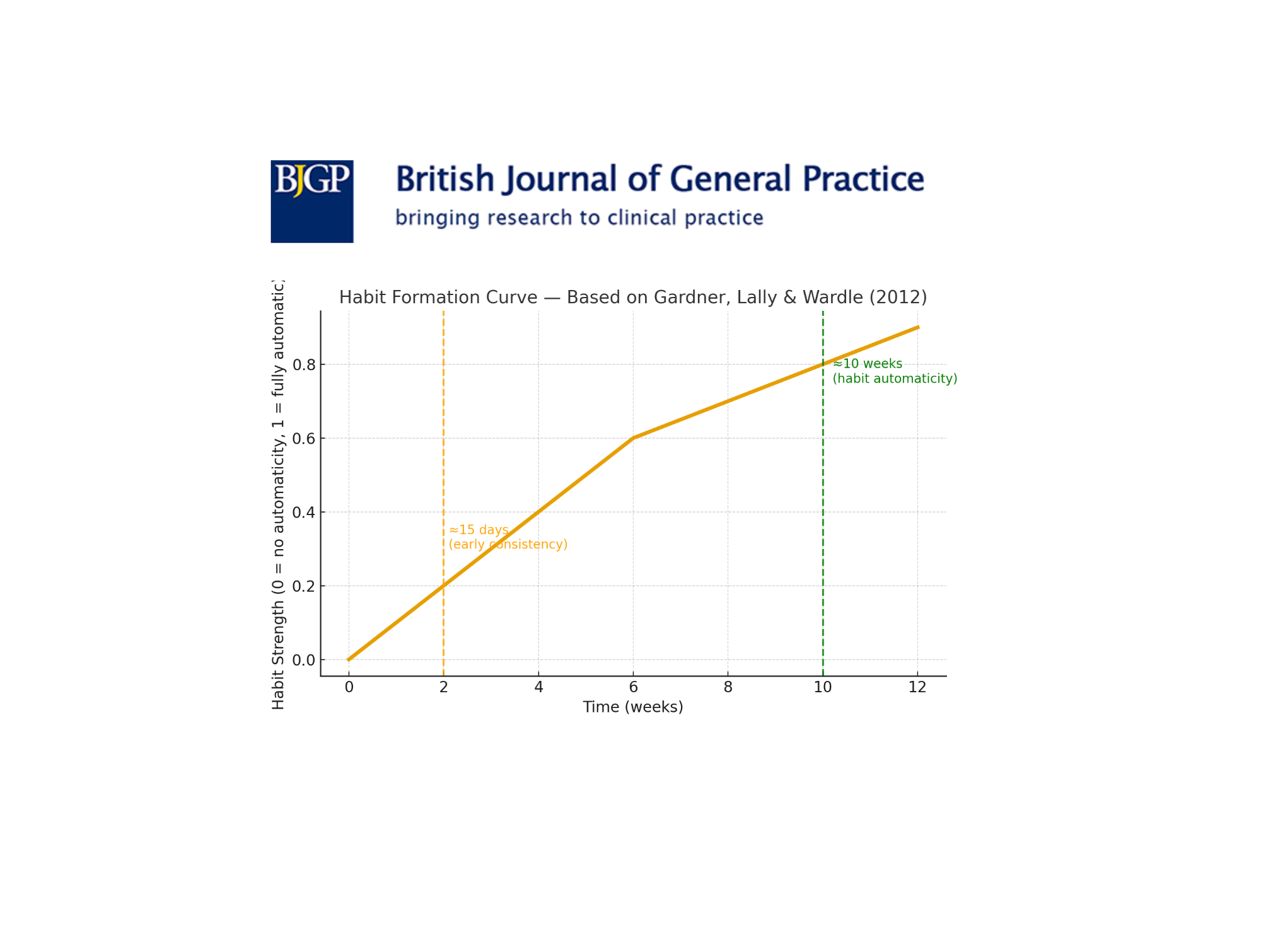
Our early research showed that users craved emotional guidance—not calorie counting—but we didn’t yet know how much time or structure they’d truly commit to. A 30-day challenge felt daunting, especially for people exhausted by “starting over.” So we chose 15 days, a duration backed by behavioral science showing that just 2–3 weeks of consistent action can spark lasting change. When people start feeling progress within that window, confidence and momentum build naturally.
To test this, I designed a 15-day self-guided challenge mirroring Bea’s intended experience: short daily reflections, gentle guided exercises, and affirmations written in Ericksonian, hypnosis-inspired language to promote emotional safety and self-compassion. Our approach drew from research in the British Journal of General Practice—and the 15-day structure we chose validated that we were successfully captivating users and guiding them toward long-term habit formation.
Validate demand and completion behavior.
Test Bea’s brand tone and writing style.
Gather early data on drop-off and retention triggers.
Goals
PHASE 2
Design: Building the Lightweight Experiment
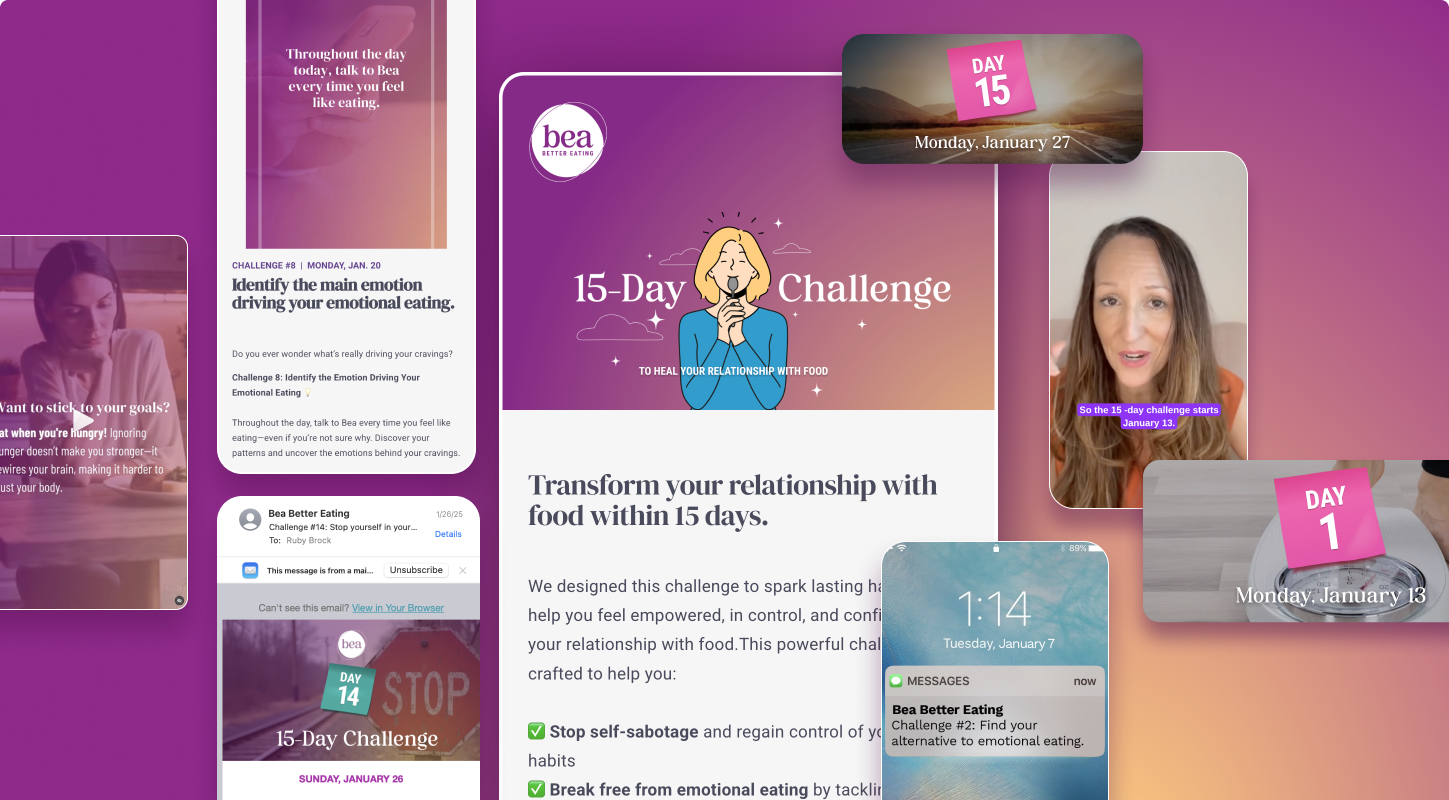
In Phase 2, we transformed Bea’s concept into a lightweight, branded experiment designed to feel real without requiring full development. By creating a cohesive mini-experience—from landing page to daily emails and SMS prompts—we tested Bea’s tone, visual identity, and emotional pacing in the wild. This lean approach allowed us to validate trust, engagement, and emotional safety before writing a single line of code.
We built a small but branded experience:
Landing page: Explained the challenge and linked to sign-up form.
Daily emails & SMS messages: Delivered short, reflective prompts with gentle hypnotic pacing.
Visual identity: Soft colors, empathetic copy, and supportive affirmations consistent with Bea’s future app tone.
Klaviyo automation: Scheduled daily prompts and tracked open rates and click-throughs
Social media posts
This format let us test messaging, pacing, and perceived emotional safety without building a single feature.
PHASE 3
Results: Quantitative Validation
Phase 3 revealed just how powerfully the experiment resonated. The 15-Day Challenge exceeded expectations across every metric—driving massive traffic growth, strong conversions, and impressive completion rates—proving that users were ready for short, structured emotional support long before the app was built.
The challenge quickly exceeded expectations:
Traffic Growth: +715 % MoM - Campaign drove strong awareness
Conversion: ~29 % (850 / 2,899) - Excellent for wellness challenge
Completion: ~9–10 % - Healthy benchmark for self-guided programs
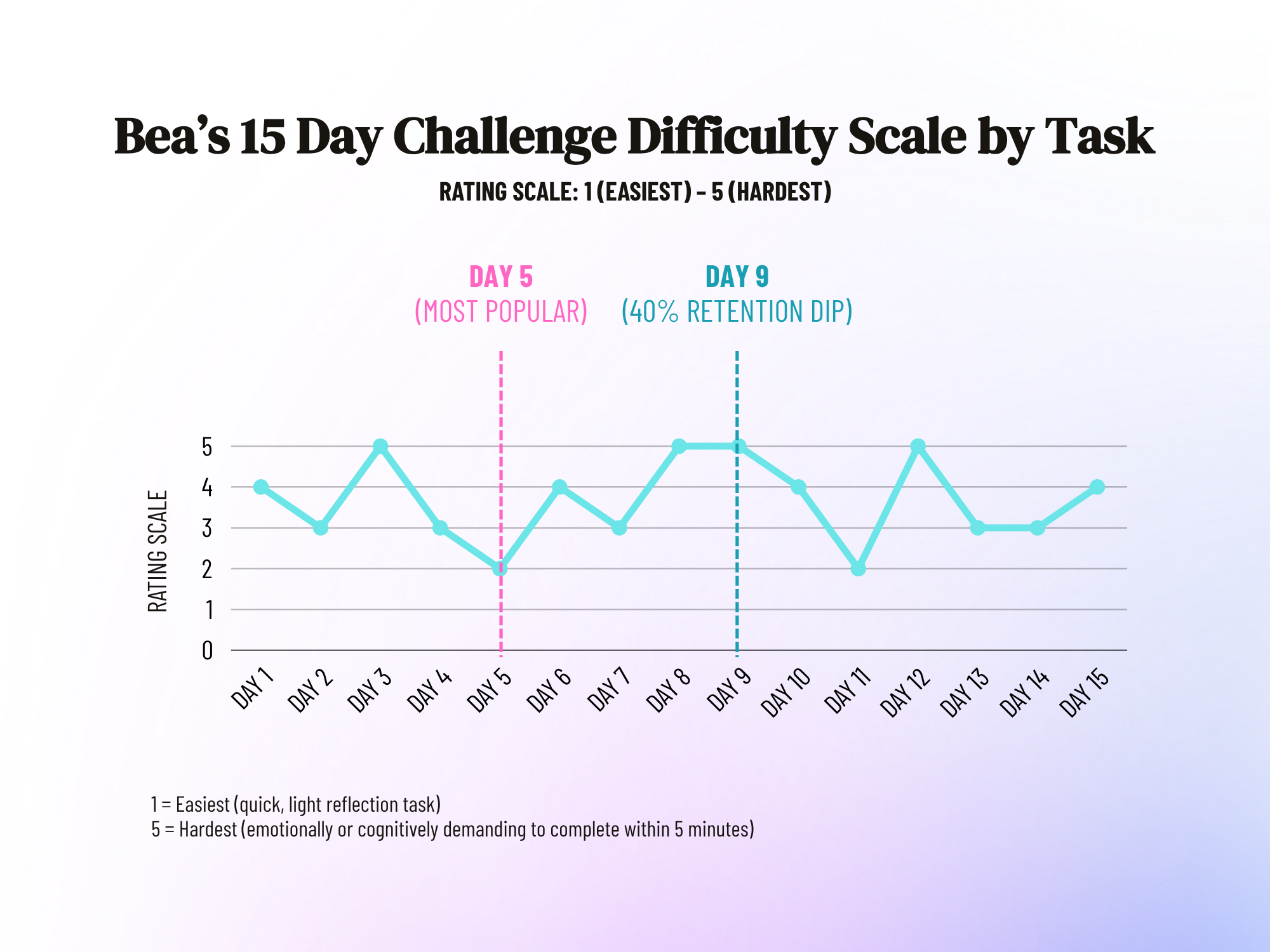
Retention Dip: 40 → 10 % by Day 9 - Indicates where motivational reinforcement needed
Most Popular Day: Day 5 - Users most engaged mid-challenge
There was clear appetite for short, structured emotional programs — validating Bea’s behavioral framing and tone long before development.
Takeaway
PHASE 4
Learnings: Insights that Shaped the Product

It was time to turn data into direction. The challenge revealed how users emotionally connected with Bea—preferring gentle reflection over rigid instruction—and surfaced insights that shaped the app’s insight dashboard and retention strategy.
Users preferred gentle guidance and self-reflection over prescriptive instruction.
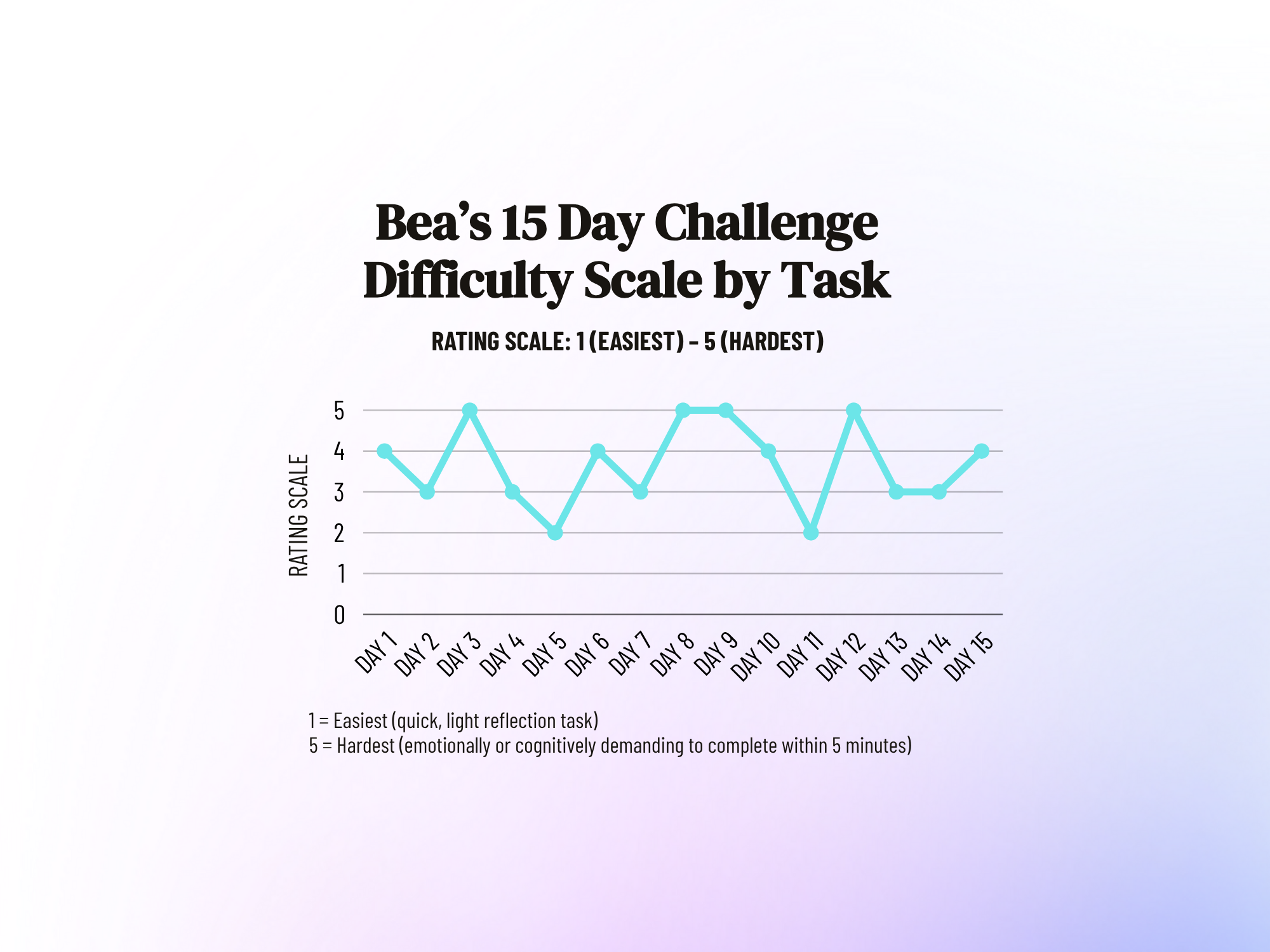
Drop-off correlated with emotional difficulty rather than boredom—highlighting the need to gently adjust those moments to improve user retention.
We renamed it “The 15-Day Reset” after learning that words like “challenge” and “tasks” felt triggering or pressure-filled for some users.
Behavioral Insights:
Set the North Star direction that aligned the team around the insight dashboard planned for the next iteration.
Early engagement confirmed that Bea’s tone felt therapeutic, not transactional.
Reinforcement mechanics (progress cues, check-ins) became must-have features for the app.
Design Implications:
The challenge provided early marketing validation and real user data that confirmed Bea’s habit-forming potential.
Informed feature prioritization: journaling, guided reflection, and emotional tracking took precedence over calorie-related features.
Advised the Bea team on sequencing daily activities from low to high emotional effort to ensure consistency and get everyone on the same page about the 15-day structure.
Business Impact:
The 15-Day Challenge became Bea’s proof of concept—validating demand, tone, and engagement before code or cost. It confirmed a key lesson: validate behavior before building behavior-change tools. This small experiment shaped Bea’s onboarding, revealed which moments drove engagement, and proved that compassion can scale through design.
REFLECTION
MORE BEA CASE STUDIES
Building Bea from Scratch
Monitoring, Metrics & Iteration (9 Months Later)